
You've probably had this happen. You spend twenty minutes explaining your business to an AI: who your customers are, how you write, what you charge. The answers get good. The next day you open a new chat, and it has no idea who you are.
That's the single biggest reason AI feels like a clever toy instead of a coworker. A coworker remembers. They remember what you decided last week, what you changed your mind about, and how you like things done.
What did I eat on June 12?
I have a personal agent that I've been logging my food with for a few months. I can ask it what I ate on June 12, four months ago, and it tells me exactly. Not a guess and not a rough summary: what I actually logged that day.
Try that with any other AI tool. It just doesn't work like that.
That's not a trick. Flashbag agents are built to remember like that. And just as important: you can always see what they remember, and where they got it from. This article explains how.
A notebook, not a black box
Every Flashbag agent has its own folder of ordinary text files. That folder is its memory. There's no hidden system somewhere in the cloud, and nothing that only exists inside the AI's head.
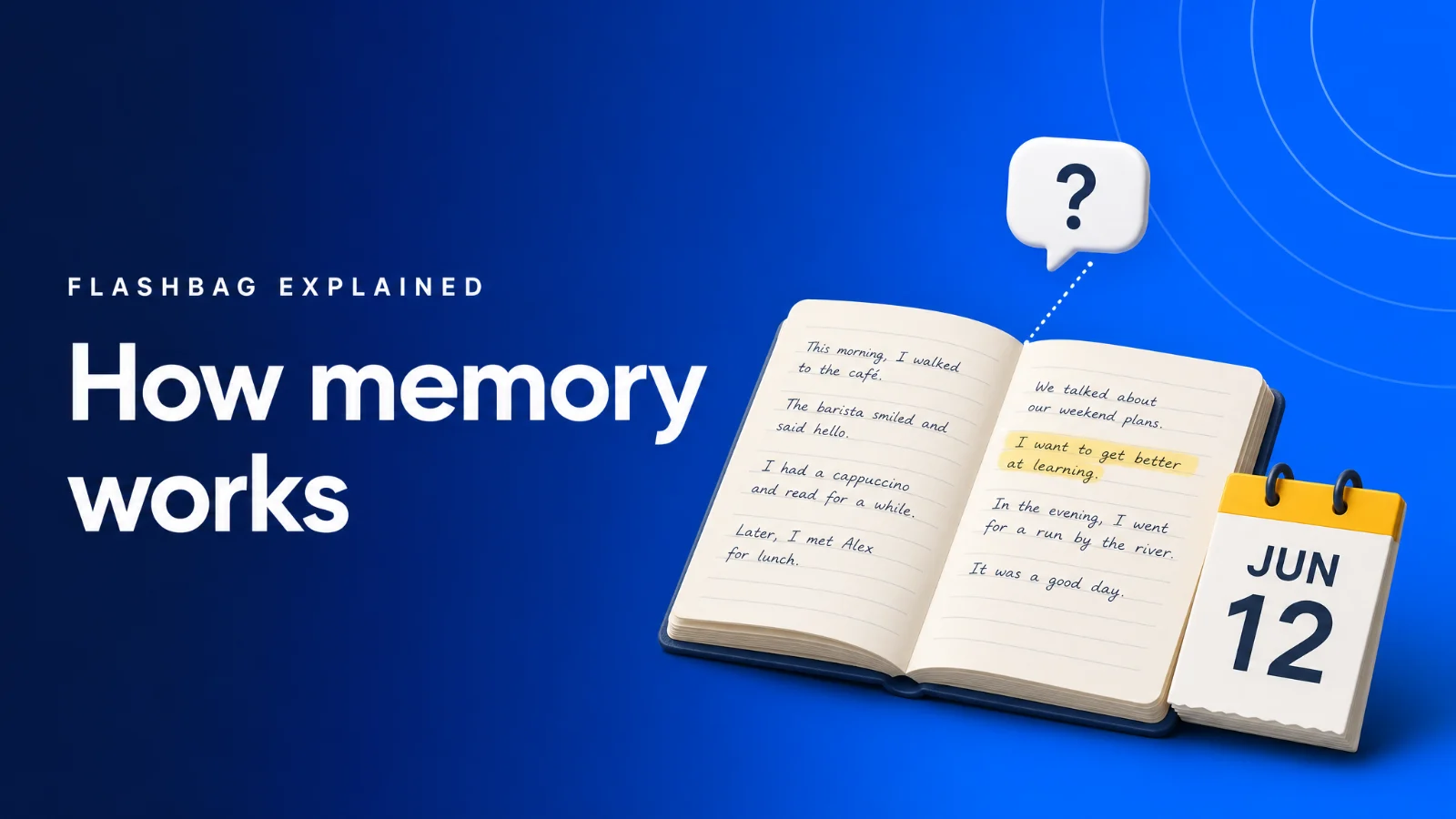
Think of a good assistant with a notebook. Every conversation gets written down. Everything important you say gets noted, with the date. When the assistant sits down to work, they read their notes first. When they need something older, they flip back and look it up.
The AI model is the assistant. The notebook is the memory. You can swap the assistant for a newer, smarter model, and the notebook stays exactly where it is.
The notes are the truth. The AI is just the one reading them.
Because these are normal files on the computer running Flashbag, you can open them in any text editor, search them, or back them up like any other document. One of the agents on our own team has worked with us for 100 days and has written down well over a thousand facts. Every one of them is readable.
Four kinds of memory
Not everything needs to be remembered the same way. A new employee doesn't memorise every email, but they do know their job description by heart. Flashbag works the same way, with four layers, from "always top of mind" to "look it up when needed":
Who the agent is
Its name, its role and how it should work. Like a job description. You write this, or Flashbag's setup helper Gordon does it for you.
Its own notes
The things worth knowing every single day: what it knows about you and your business, and the rules it has learned. Kept short on purpose.
Facts
Short statements picked out of your conversations, like "invoices go out on the 1st". Each one is dated and points back to where you said it.
The full conversation
Every message, written down day by day. Nothing is summarised away, so the original is always there to check.
There's one more nice touch. Things that are true for all your agents, like your name, your company and the language you write in, live in one shared note. You tell it once, and every agent knows it. No more introducing yourself to each new agent.
What happens when you send a message
Here's what goes on behind a single message, in three moments.
- Before: the briefing. When a new conversation starts, the agent reads its job description, its own notes, the most recent part of your conversation, and the facts from that same stretch of time. Like reading your notes before a meeting.
- During: looking things up. If you ask about something older than what it just read, the agent searches its notebook, the way you'd search your email. It doesn't have to guess.
- After: taking notes. Once you have your reply, a second, cheaper AI reads that exchange and suggests what's worth remembering. You never wait for this; your answer comes first.
That last step has an important detail. The AI that suggests notes isn't allowed to write them down itself. AI is good at spotting what matters, but it's not a reliable bookkeeper. So every suggestion goes past a strict gatekeeper, plain software with fixed rules:
- No duplicates. If the same fact was just written down, it isn't written again.
- Agents only correct their own notes. One agent can never change what another agent remembers.
- The notebook comes first. A fact is written to the file before anything else, so a hiccup can't make it disappear.
And if note-taking ever fails, your reply is still delivered and the conversation is still saved. You'll see a small marker on that message so you know some notes from that moment may be missing.
Every fact comes with a receipt
A fact in Flashbag isn't just a loose sentence. It comes with everything you need to check it. Here's what one looks like:
Invoices go out on the first working day of the month.
“Oh, and invoices always go out on the first working day of the month.”
Four things make this more than a note:
- The fact itself, in a short, clear sentence.
- Your own words, quoted, so you can see whether the summary is right.
- When it was written down, kept apart from any date the fact talks about.
- Where it came from: the exact conversation and message, so you can go back and read what was actually said.
So when an agent says something that sounds off, you don't have to argue with it. You open the source and look.
That's the difference between an AI that says it remembers, and one that can show you.
Changing your mind doesn't erase history
Say you tell an agent: "Actually, the price is €97, not €147." Flashbag doesn't rub out the old note. It writes a new one that says this replaces that.
Think of crossing something out with a single neat line instead of using correction fluid. You can still read what was there, but it's clear it no longer counts.
- Your agent works with the current version. Replaced facts are left out of what it uses day to day.
- The history is still there. "What price did we use in August?" is a question it can still answer.
- Corrections stack up neatly. If you change your mind twice, the latest version wins, and the original never sneaks back in.
"Started fresh" doesn't mean it forgot
This is the one that confuses people most. Now and then you'll see a "started fresh" line in a chat. It looks like the agent wiped its memory. It didn't.
An AI model has a kind of short-term memory: the conversation it's holding in its head right now. That space is limited, and the fuller it gets, the slower and more expensive every reply becomes. So Flashbag clears it from time to time, on purpose and always visibly. That happens when:
- A new day starts and you haven't talked for over an hour, so it never cuts you off mid-conversation late at night.
- A conversation gets very long.
- You click "Start fresh" yourself.
- You switch AI model or service.
It's like closing your laptop at the end of the day. Tomorrow you won't remember every sentence from today's meetings, but your notes are all still there. The agent's notebook (its own notes, the facts and the full conversation) stays untouched. When the next conversation starts, it reads its briefing again and carries on.
Restarting Flashbag or pressing Stop on a reply does not start a fresh conversation.
Why this matters for your business
All of this comes down to a few simple promises:
- It's yours. The memory lives as plain files on the computer running Flashbag. Not locked inside someone else's system.
- You can check it. Every fact points back to the moment it was said. Nothing happens silently.
- It doesn't get more expensive with age. An agent only reads its short notes and the recent conversation at the start, and looks the rest up when needed. A 100-day-old agent costs about the same to start as a 10-day-old one, as long as its own notes stay tidy.
- It survives model changes. New AI models come out every few months. Your agents' memory moves with you to whichever one you choose.
- Nothing gets lost. Even when something goes wrong, the conversation is saved and the reply is delivered.
The result is an agent that gets better at working with you the longer you work together, the way a good coworker does, without you ever having to take its word for it.

Your agents remember, and you can check.
Start your free 14-day trial and give your first agent something worth remembering.